

Delegate Everything You Can to AI Agents
Every task you do yourself that an AI agent could do is a choice to fall behind, and in the past year that list grew to include writing code, operating a computer and even research.

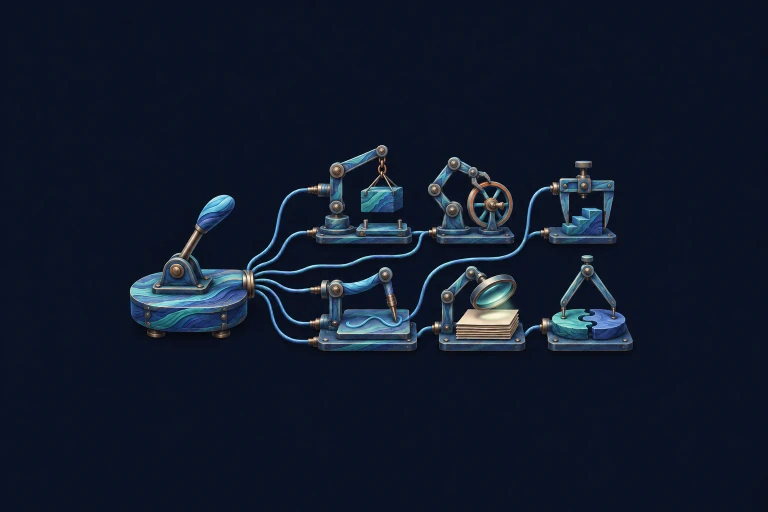
Every task you do yourself that an AI agent could do for you is a choice to fall behind.
A year ago that sentence was an exaggeration. Today it is just true. AI agents can now do all of the work of writing software, and they can operate a computer for nearly any task a person does at a desk. That is an enormous amount of power, and most people are still leaving it on the table.
So here is my argument, in four lines:
- AI got radically better in the past year.
- That is an enormous amount of power, and not using it is falling behind.
- So automate your workflows now: all of the grunt work, including the thinking work, like research.
- Everything an agent can do, it should do. Your job is to direct, decide and own the outcome.
I have already written about what this job feels like in I Don’t Write Code Any More, and why it applies to every profession in Everybody Is a Director of AI Now. This post makes one narrower claim: delegate everything you can, starting this week, and don’t stop at the easy parts.
What changed in the past year
Look at one benchmark. OSWorld asks an agent to finish ordinary tasks on a real computer, using the mouse and keyboard. When its authors published it in April 2024, people completed 72.36% of the tasks and the best model completed 12.24% (OSWorld).
- October 2024. Anthropic launched computer use at 14.9% and called it “experimental—at times cumbersome and error-prone” (Anthropic).
- September 2025. Claude Sonnet 4.5 reached 61.4%, and Anthropic saw it stay focused “for more than 30 hours on complex, multi-step tasks” (Anthropic).
- June 2026. Under a revised method, Anthropic reported 78.5% for Claude Sonnet 4.6, above the human rate the benchmark’s authors measured (Anthropic).
Coding moved the same way. In November 2025, Anthropic reported that Claude Opus 4.5 scored higher on its take-home engineering exam than “any human candidate ever” within the two-hour limit (Anthropic). By January, Boris Cherny, who leads Claude Code, said his code had been 100% written by AI “for two+ months now, I don’t even make small edits by hand” (Fortune).
And the length of work an agent can take on keeps growing. METR found that length had been “doubling approximately every 7 months for the last 6 years” (METR). Its tracker now warns that measurements above 16 hours are unreliable with its current task suite (METR). The yardstick is running out.
Not using it is falling behind
The people building this said so early. In October 2024, Dario Amodei described AI that “can be given tasks that take hours, days, or weeks to complete” and then “goes off and does those tasks autonomously” (Machines of Loving Grace). In June 2025, Sam Altman wrote: “2025 has seen the arrival of agents that can do real cognitive work; writing computer code will never be the same” (The Gentle Singularity).
The companies that took them at their word changed their rules. In April 2025, Shopify’s CEO Tobi Lütke told his company that “reflexive AI usage is now a baseline expectation at Shopify,” and that teams must show why AI can’t do a job before asking for more resources (Digital Commerce 360).
That was a year and a half ago. The agents are much better now. If you still treat them as an optional extra, you are competing against people who don’t.
Delegate the thinking too
Most people who use AI hand it the rote work: format this, summarize that, fix the typo. Then they keep the “real” work for themselves: the research, the analysis, the first draft, the plan.
That is backwards. The thinking work is where agents are now strong. Anthropic reports that Claude Opus 4.6 beat GPT-5.2 by about 144 Elo points on GDPval-AA, a test of economically valuable knowledge work in finance, law and other fields, and a legal customer says Claude Sonnet 5’s clearest gains are “in legal research and analysis” (Anthropic, Anthropic).
So here is the rule I follow: if an agent can do it, an agent does it. Not just the boring part. Research, drafting, analysis, code, review, publishing. What I keep is the part no agent can own for me: deciding what we do, and taking responsibility for the result.
This post is the proof
Here is the turn. I didn’t research this post, and I didn’t draft it.
This morning I gave my issues agent the argument and the structure. It filed the work as issue #228 at 13:02 UTC. A coding agent claimed it, searched for sources, read each one, dropped the quotes it couldn’t check and committed its research report to the repository, with a list of what it threw out. It drafted this post from that report. A separate agent in a different harness made the cover. Another agent reviews the pull request before it can merge. My job was the direction at the start and the decision to publish at the end.
That’s not a stunt. It is how this site runs every day. Yesterday, in this
one repository, agents merged 31 pull requests and put 96 commits on main.
In October I averaged 156 commits a day across all of my repositories, 8
times my 2024 rate of 19.3 (my CV, and
I Make 156 Commits a Day Now).
From November 8 to 11, my agents merged 207 pull requests across four
repositories, 93 of them in one day (my CV).
I don’t produce those numbers by working harder. I produce them by doing almost none of the work.
Direct, decide and own the outcome
Delegating everything doesn’t mean caring about nothing. The more you hand off, the more your remaining job matters:
- Direct. Say what you want, what good looks like and what doesn’t count.
- Decide. Agents surface options. You choose, and you say no.
- Own the outcome. When it ships under your name, it’s yours. Check the work, and when an agent gets it wrong, fix the instructions, not just the output.
Start this week
- List your week. Write down every task you did in the last five working days, including the thinking tasks.
- Hand over the research first. Pick one question you would normally spend an afternoon on. Have an agent research it from primary sources and write a report with links. Check three of the links yourself.
- Hand over one repeated task. The report, the email, the reconciliation you do every week. Write a one-page brief and let the agent do it from now on.
- Keep context agents can read. Put your briefs, rules and decisions in plain files you control, so any agent can pick up any job. I explain why and how in Own Your Memory.
- Review with a second agent. Never let the agent that did the work approve its own work. Then you review the result, not every step.
- Next week, delete another task from your own list. Keep going until your list is only directing, deciding and owning.
The agents got radically better this year. The only question left is how much of your week you’re still doing by hand.